


Is Your Inherited Roth Protected? Why “Set It and Forget It” is a Dangerous Strategy

Quick Overview: Inherited Roth IRA Essentials
- Who Can Inherit: Spouses, children, other individuals, trusts, or estates
- Spousal Options: Treat as own IRA, stretch distributions over lifetime, or follow 10-year rule
- Non-Spouse Rules: Most must withdraw all funds within 10 years (for deaths after 2019)
- Tax Treatment: Contributions always tax-free; earnings tax-free if account existed 5+ years
- Exceptions: Eligible designated beneficiaries (disabled, chronically ill, minors, or those within 10 years of owner’s age) can stretch distributions
- Key Deadline: December 31 of the 10th year after owner’s death
- Penalty: 25% IRS penalty on remaining balance if 10-year deadline missed
Inheriting a Roth IRA can be overwhelming, and a misstep can trigger hefty penalties. The rules differ dramatically based on your relationship to the deceased and when they passed away.
The SECURE Act, effective from 2020, fundamentally changed how most beneficiaries handle inherited accounts. For most non-spouse beneficiaries, the “stretch” IRA was replaced by a strict 10-year withdrawal window. Understanding whether you’re a spouse, an eligible designated beneficiary, or a standard designated beneficiary is the first step in determining your strategy.
When handled correctly, inherited Roth IRAs offer powerful tax advantages. Unlike traditional IRAs, qualified distributions from Roth IRAs are completely tax-free. If the account has existed for at least five years, you can access all funds without owing a penny to the IRS—as long as you follow the rules.
I’m Michael Ginsberg, JD, CFP®, and for over 25 years, I’ve guided families through the complexities of inherited Roth IRAs. My experience as a former estate planning attorney provides unique insight, helping you maximize tax advantages and avoid costly mistakes.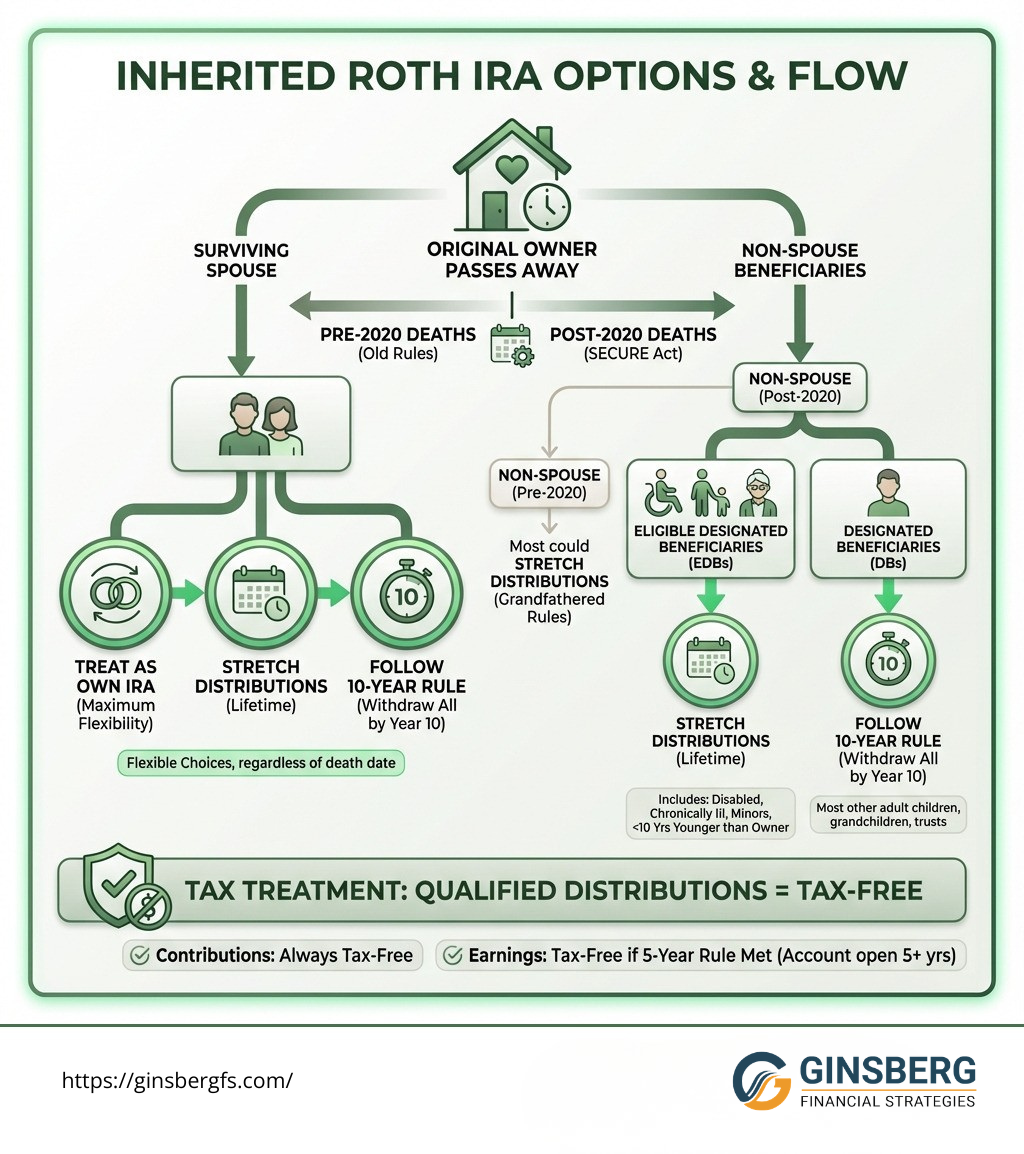
Inheriting a Roth IRA introduces a new layer of financial complexity. The rules, especially since the SECURE Act, are intricate, and your path depends on your relationship to the original owner and their date of death. This roadmap will help you understand your options, tax implications, and how to avoid common pitfalls.

Who Can Inherit and What Are Your Options?
Beneficiaries can be spouses, children, friends, trusts, or estates. The IRS classifies beneficiaries into three main types, which determines your options:
- Eligible Designated Beneficiary (EDB): Includes surviving spouses, the owner’s minor children, disabled or chronically ill individuals, and anyone not more than 10 years younger than the owner. This group has the most flexibility.
- Designated Beneficiary: Most non-spouse individuals who are not EDBs (e.g., an adult child).
- Non-Designated Beneficiary: Non-person entities like estates or charities, which face the fastest distribution rules.
Surviving Spouse Options
Surviving spouses have the most favorable options:
- Treat as Your Own: Roll the assets into your own Roth IRA. This allows the money to continue growing tax-free, and you won’t face required minimum distributions (RMDs) in your lifetime. You can also name your own beneficiaries.
- Open a Beneficiary IRA: Keep the account as an inherited IRA. You can stretch distributions over your lifetime, but you cannot make new contributions.
- Lump-Sum Distribution: Withdraw all funds at once. This is tax-free if the account met the 5-year holding period but forgoes future tax-free growth.
Non-Spouse Beneficiary Options
For deaths after 2019, the SECURE Act created stricter rules for most non-spouses:
- Eligible Designated Beneficiary (EDB): If you are an EDB, you can stretch distributions over your life expectancy, preserving tax-free growth. For minor children, this lasts until they reach the age of majority (typically 21), at which point the 10-year rule applies to the remainder.
- Designated Beneficiary (Non-EDB): Most non-spouse beneficiaries must follow the 10-year rule, requiring the entire account to be emptied by the end of the 10th year after the owner’s death.
Opening an Inherited IRA Account
To preserve the tax-advantaged status, you must open a properly titled inherited Roth IRA (e.g., “John Smith Deceased FBO Jane Doe, Beneficiary”). Always use a direct trustee-to-trustee transfer to move the funds. This avoids accidental distributions that could trigger taxes and penalties. The decisions you make have lasting financial implications, which is why we at Ginsberg Financial Services are here to help. For more information, explore our More info about our services.
The 10-Year Rule and Its Exceptions
The 10-year rule, introduced by the SECURE Act, is a major change for inherited IRAs. For deaths on or after January 1, 2020, it eliminated the “stretch IRA” for most non-spouse beneficiaries.
The 10-Year Withdrawal Rule
This rule requires most non-spouse designated beneficiaries to withdraw the entire balance of the inherited Roth IRA by December 31st of the 10th year following the owner’s death. There are no annual RMDs within this period, offering flexibility on when you take withdrawals, but the account must be empty by the deadline.
Eligible Designated Beneficiary Exceptions
Eligible Designated Beneficiaries (EDBs) are exempt from the 10-year rule and can still stretch distributions over their life expectancy. This includes:
- Surviving Spouses
- Minor children of the original owner (until they reach the age of majority)
- Disabled or chronically ill individuals
- Individuals not more than 10 years younger than the owner
Deaths Before vs. After 2020
- Deaths Before January 1, 2020: The old “stretch IRA” rules generally apply. Non-spouse beneficiaries could typically take distributions over their life expectancy.
- Deaths On or After January 1, 2020: The SECURE Act’s 10-year rule and EDB exceptions are in effect.
If you’re unsure which rules apply, review the Detailed rules from the IRS or consult a professional.
Tax Implications and the 5-Year Rule for Inherited Roth IRAs
An inherited Roth IRA offers the potential for tax-free withdrawals, but this isn’t guaranteed.
- Contributions: Withdrawals of the original owner’s contributions are always tax-free.
- Earnings: For earnings to be withdrawn tax-free, the original Roth IRA must have been established for at least five years. The 5-year clock starts on January 1 of the year the original owner first funded any Roth IRA.
If the account is less than five years old, withdrawn earnings will be subject to income tax. The penalty for failing to empty the account under the 10-year rule is a steep 25% IRS penalty on the remaining balance.
Compared to an inherited traditional IRA, where nearly all distributions are taxed as ordinary income, the tax-free nature of a qualified inherited Roth IRA is a significant advantage. For more insights, visit our Retirement Planning blog.
Common Questions About Managing Inherited Roth IRAs
Here are quick answers to common questions about your inherited Roth IRA.
Can I Contribute to an Inherited Roth IRA?
No. A non-spouse beneficiary cannot contribute to an inherited IRA. The only exception is a surviving spouse who treats the IRA as their own.
Are There RMDs for Inherited Roth IRAs?
Yes, beneficiaries have withdrawal requirements. EDBs stretching distributions have annual RMDs. Those under the 10-year rule must withdraw the entire balance by the deadline. While the withdrawals may be tax-free, the requirement to take them is mandatory.
What if There Are Multiple Beneficiaries?
The account should be split into separate inherited IRAs for each person. This allows each beneficiary to follow the rules applicable to them and make their own withdrawal decisions.
Can I Disclaim an Inheritance?
Yes, you can refuse the inheritance in writing within nine months of the owner’s death, provided you haven’t taken any benefit from it. The assets then pass to the contingent beneficiary. This is a complex decision that requires professional advice.
Should I Consult a Professional?
Absolutely. The rules are complex and mistakes are costly. A qualified financial advisor can help you understand your options, create a withdrawal strategy, and integrate the inheritance into your overall financial plan. See our See our FAQs for more answers to common financial questions.
Securing Your Financial Future with Your Inheritance
Inheriting a Roth IRA is a unique financial opportunity, but it demands attention and informed decisions to open up its full value. Successfully navigating the rules is key to avoiding penalties and maximizing tax-free growth.
The key is to identify your beneficiary category, understand the 10-year rule if it applies, and be mindful of the 5-year holding period for earnings. The SECURE Act reshaped the landscape, making proactive planning more critical than ever, especially for non-spouse beneficiaries.
Integrating Your Inheritance into a Lifelong Strategy
An inheritance is an opportunity to make smart decisions that can profoundly impact your financial future. Your inherited Roth IRA should not exist in a vacuum; it must be integrated into your overall financial plan.
Maximizing the tax advantages means carefully considering when to take distributions. For those under the 10-year rule, your personal income and financial needs will influence whether you withdraw funds gradually or all at once. For EDBs, stretching distributions allows for decades of continued tax-free growth—a powerful advantage.
At Ginsberg Financial Services, we specialize in helping individuals create a comprehensive plan that makes the most of every asset. Our approach, embodied in our Lifetime Wealth Blueprint, is designed to guide you through wealth transitions. We help you make smart decisions and avoid costly mistakes, ensuring your inheritance supports your long-term financial well-being.
Don’t let the complexities of an inherited Roth IRA deter you. With careful planning and professional guidance, you can transform this inheritance into a powerful component of your financial security. Contact us today to begin integrating your inheritance into your lifelong strategy.