


Don’t Leave Money on the Table: A Guide to Maximizing Your Social Security

Your Foundation for a Secure Retirement
For most Americans, Social Security is the bedrock of retirement income. Yet, the average monthly benefit of $1,710.78 barely covers typical housing costs for those over 65, let alone healthcare. Learning how to maximize social security income is therefore essential.
The reality is stark: only 42% of Americans can correctly answer a basic question about how Social Security benefits are calculated. This knowledge gap costs retirees thousands. For example, claiming at age 62 versus 70 can mean a 30% reduction or a 24% increase in your monthly benefit, a difference that can compound for decades.
The good news is that strategic planning can dramatically boost your income. Delaying benefits increases your payment by 8% per year after full retirement age, and coordinating spousal benefits can further optimize a household’s income.
I’ve spent over 25 years helping clients with retirement income planning, focusing on maximizing Social Security as the foundation of a secure strategy. My Lifetime Wealth Blueprint™ starts by optimizing these benefits before layering in other income sources to create lasting financial security.
Navigating Social Security can feel complex, but the right strategies can ensure you get every dollar you’ve earned. Let’s explore the core strategies for how to maximize social security income.
1. Boost Your 35-Year Earnings Record

Your Social Security benefit is based on your lifetime earnings. The Social Security Administration (SSA) calculates it using your highest 35 years of earnings, indexed for inflation. If you work for fewer than 35 years, the SSA inserts a “0” for each missing year, which can significantly lower your benefit.
A key insight into how to maximize social security income is to work for at least 35 years. If you have low-earning years, continuing to work—even part-time—can replace those lower figures and boost your monthly check. We often see clients in Walnut Creek, CA, surprised by how a few extra years of work impact their benefits.
It’s also vital to ensure your earnings record is accurate. Regularly check your Social Security Statement via your “my Social Security” account online and report any errors to the SSA. If you have a pension from a job not covered by Social Security, your benefit might be reduced by the Windfall Elimination Provision (WEP) or Government Pension Offset (GPO). For a deeper dive into creating a custom retirement plan, explore our comprehensive retirement planning services.
2. Choose the Optimal Time to Claim
Deciding when to claim Social Security is the most impactful decision you’ll make to maximize social security income. Your Full Retirement Age (FRA)—the age you receive 100% of your benefit—is 67 for anyone born in 1960 or later. You can find your specific FRA using the SSA’s Retirement Age Calculator.
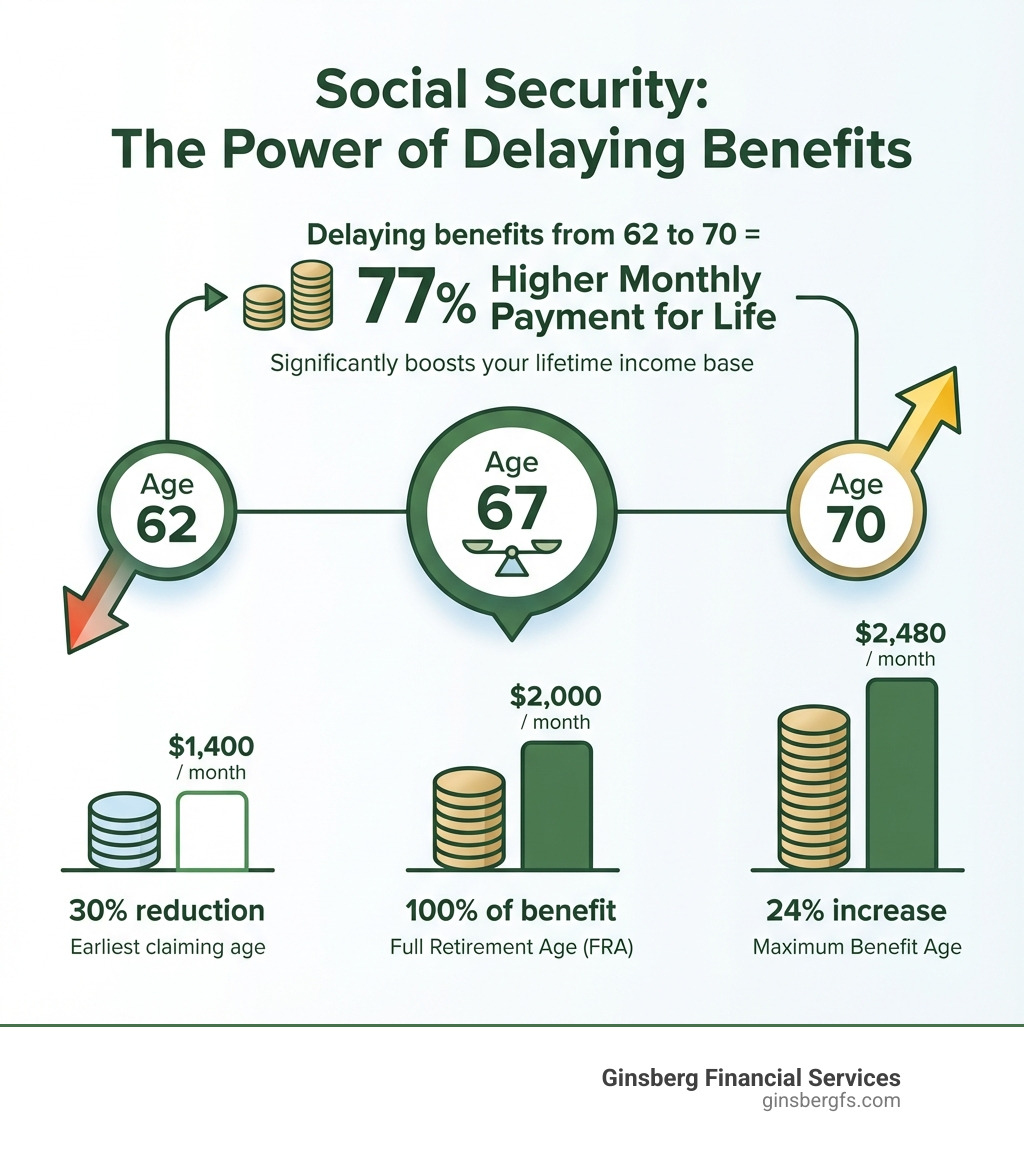
Claiming before your FRA results in a permanent reduction. For example, if your FRA is 67, claiming at 62 reduces your benefit by 30%. A $2,000 monthly benefit shrinks to just $1,400.
Conversely, delaying your claim past your FRA earns you Delayed Retirement Credits. Your benefit increases by about 8% for each year you wait, up to age 70. If your FRA is 67, waiting until 70 boosts your benefit by 24%. That same $2,000 benefit becomes $2,480—a 77% higher monthly payment compared to claiming at 62.
When to claim depends on your health and longevity. With 1 in 3 65-year-olds today expected to live past 90, delaying can mean significantly more lifetime income. Finally, your annual Cost-of-Living Adjustments (COLAs) will be applied to a larger base benefit if you delay, further increasing your purchasing power.
3. How to Maximize Social Security Income While Still Working

Continuing to work while receiving benefits can be a great way to maximize social security income, but you must be aware of the annual earnings test. If you are younger than your Full Retirement Age (FRA) and earn over a certain limit, some of your benefits will be temporarily withheld.
For 2025, the limit is $23,400. For every $2 you earn above this, $1 is deducted from your benefits. A higher limit applies in the year you reach FRA. Once you hit your FRA, the earnings test disappears. The SSA has a helpful guide called How Work Affects Your Benefits.
The good news is that withheld benefits aren’t lost. At your FRA, the SSA recalculates your benefit to credit you for those months, resulting in a higher future payment. Furthermore, if your current earnings are higher than one of your past 35 years, the SSA automatically recalculates your benefit, potentially increasing it.
You can also claim up to six months of retroactive benefits if you apply after your FRA. However, this comes with a trade-off: your ongoing monthly payment will be permanently lower. For most, foregoing this lump sum for a higher lifetime monthly payment is the better strategy.
4. How to Maximize Social Security Income by Coordinating Benefits
For married and divorced individuals, coordinating benefits is a powerful way to maximize social security income for the household.
Here are the key benefit types to understand:
- Spousal Benefits: At your Full Retirement Age (FRA), you may be eligible for a benefit of up to 50% of your spouse’s full retirement benefit. You’ll receive the higher of your own benefit or the spousal benefit.
- Divorced-Spouse Benefits: If you were married for at least 10 years and are currently unmarried, you may be eligible for benefits on your ex-spouse’s record.
- Survivor Benefits: A surviving spouse can receive up to 100% of the deceased worker’s benefit. This makes the higher earner’s claiming decision critical for the long-term security of their partner.
A common coordination strategy is for the higher-earning spouse to delay claiming until age 70. This maximizes their own benefit and, crucially, provides the largest possible survivor benefit. The lower-earning spouse might claim their own benefit earlier to provide household income. Since survivor benefits are based on the deceased’s actual payment, the higher earner delaying their claim provides a powerful financial safety net. These strategies require careful planning, which we detail in our Securing Lifetime Retirement Income Case Study.
5. Don’t Overlook Critical Medicare Deadlines
While not part of Social Security, missing Medicare deadlines can lead to permanent penalties that reduce your retirement income. This makes understanding Medicare crucial for any plan to maximize social security income.
Most people become eligible for Medicare at age 65. Even if you delay Social Security, you should generally enroll in Medicare at 65. The most critical deadline is for Medicare Part B. If you don’t sign up when first eligible, you may face a permanent late enrollment penalty—an extra 10% for each 12-month period you delayed.
Are you still working at 65 with employer health insurance? If your employer has 20 or more employees, you might be able to delay Part B without penalty. However, you must confirm this with your benefits administrator. If you lose employer coverage before 65, you might consider COBRA for temporary continuation of health coverage. Don’t let these deadlines sneak up on you; a small oversight can lead to a lifetime of higher healthcare costs.
Build Your Comprehensive Retirement Income Plan

We’ve covered key strategies on how to maximize social security income, from optimizing your earnings record to coordinating spousal benefits. The main takeaway is that Social Security is not a “set it and forget it” benefit. Strategic decisions, like delaying your claim from age 62 to 70, can result in a 77% higher monthly payment for life.
But Social Security is just one piece of the puzzle. True retirement confidence comes from a personalized income plan that integrates all your assets and income streams.
At Ginsberg Financial Services, we help families in Walnut Creek, CA, and the East Bay create a simple, non-conventional roadmap to a secure retirement. We focus on generating reliable income and protecting your portfolio from volatility, ensuring your money works for you.
Our process culminates in your own Lifetime Wealth Blueprint. This is your personalized guide to financial security, designed to help you steer retirement with confidence. Don’t leave money on the table or your retirement to chance. Let’s work together to build a robust income plan that maximizes every dollar you’ve earned.