


Don’t Get Taxed Out: Clever Ways to Minimize RMDs

Why Minimizing RMD Taxes Matters for Your Retirement Security
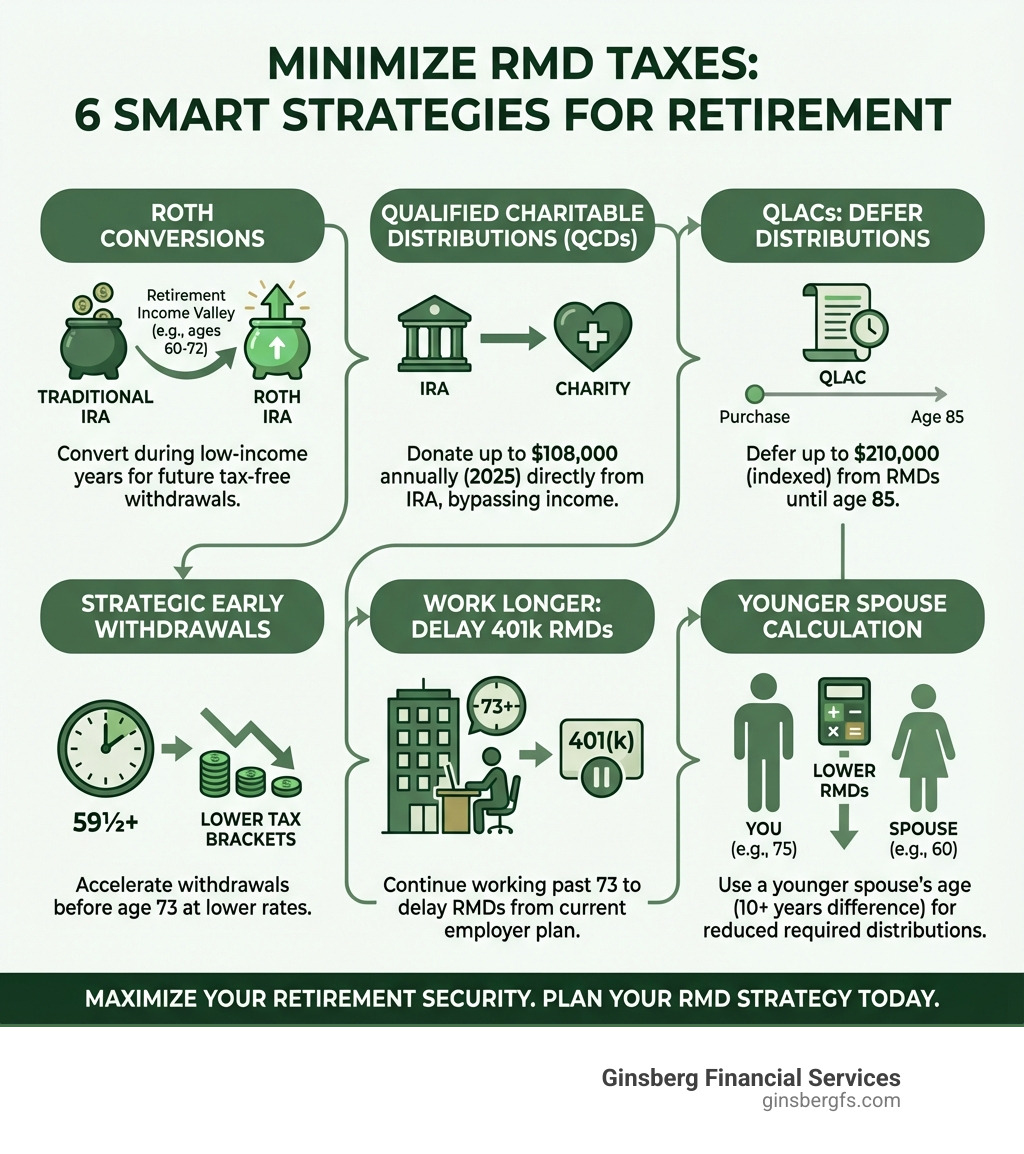
Minimize RMD taxes and you could save tens of thousands of dollars over your retirement. Here are the top strategies to reduce your tax burden from Required Minimum Distributions (RMDs):
- Convert to a Roth IRA during low-income years between retirement and age 73.
- Use Qualified Charitable Distributions (QCDs) to donate directly from your IRA ($108,000 limit in 2025).
- Purchase a QLAC to defer up to $210,000 from RMD calculations until age 85.
- Accelerate withdrawals before age 73 when you’re in lower tax brackets.
- Continue working past 73 to delay RMDs from your current employer’s 401(k).
- Use a younger spouse (10+ years) for lower RMD calculations.
Once you turn 73, the IRS requires you to take mandatory withdrawals from your tax-deferred retirement accounts. These RMDs are taxed as ordinary income and grow larger each year, potentially pushing you into higher tax brackets. This forced income can also trigger “stealth taxes” like higher Medicare premiums and increased taxes on Social Security benefits.
The good news is that you have more control than you think. With proper planning, you can significantly reduce the tax impact of RMDs, pay taxes at lower rates, or even turn mandatory withdrawals into opportunities for charitable giving.
As Michael Ginsberg, JD, CFP®, I’ve spent over 25 years helping clients develop strategies to minimize RMD taxes through my Lifetime Wealth Blueprint℠. I’ll walk you through six proven strategies that can help you keep more of your hard-earned retirement savings.
Understanding the RMD Tax Bite
Required Minimum Distributions (RMDs) are mandatory annual withdrawals from most tax-deferred retirement accounts, such as traditional IRAs and 401(k)s, starting at age 73. Because you received a tax break on contributions and growth, the IRS requires these withdrawals to finally collect taxes on the money. RMDs are taxed as ordinary income. Notably, Roth IRAs have no RMDs for the original owner.
The penalty for failing to take your full RMD is steep: 25% of the amount you failed to withdraw. This can be reduced to 10% if corrected promptly, but it’s a costly mistake. You can find official guidance on the IRS’s Retirement Topics – Required Minimum Distributions (RMDs) page.
This system creates an “RMD Waterfall” effect. As you age, the percentage of your account you must withdraw increases. This accelerating withdrawal rate can push you into higher tax brackets, even if your account balance is shrinking. It forces you to take taxable income, whether you need it for living expenses or not, which is why planning is so critical.
6 Smart Strategies to Minimize RMD Taxes
Now that we understand the RMD landscape, let’s explore how we can steer it more efficiently to minimize RMD taxes.
1. Convert to a Roth IRA During Your ‘Retirement Income Valley’
Converting funds from a traditional IRA or 401(k) to a Roth IRA is a powerful way to reduce future RMDs. Roth IRAs have no RMDs for the original owner, and qualified withdrawals are tax-free.
The best time for conversions is often the ‘retirement income valley’—the years between retiring and starting RMDs at age 73. Your income may be lower during this window, allowing you to pay conversion taxes at a lower rate. By converting, you “pre-pay” taxes and reduce the account balance that will be subject to future RMDs.
The benefits include:
- Tax-free growth and withdrawals in retirement.
- No lifetime RMDs, giving you full control.
- A more tax-efficient inheritance for your beneficiaries.
Be mindful of the 5-year rules for Roth conversions to avoid penalties. Spreading conversions over several years can help manage the tax impact. We often help clients analyze these scenarios in our Retirement Income Planning Case Study.
2. Use a Qualified Charitable Distribution (QCD) to Fulfill Your RMD
For those 70½ or older, a Qualified Charitable Distribution (QCD) is a superb way to minimize RMD taxes and support charities. A QCD allows you to transfer money directly from your IRA to an eligible nonprofit.
The benefits are significant:
- The transfer counts toward your RMD for the year.
- The amount is excluded from your taxable income, which can help you avoid higher Medicare premiums and other “stealth taxes.”
- You get the tax benefit even if you don’t itemize deductions.
For 2026, you can donate up to $108,000 from your IRA as a QCD. This is a per-person limit, and the funds must go directly from your IRA to the charity. Unlike taking an RMD and then donating, a QCD keeps the distribution out of your adjusted gross income (AGI), making it a much more tax-efficient way to give. This strategy applies to IRAs, not 401(k)s.
3. Defer Distributions with a Qualified Longevity Annuity Contract (QLAC)
A Qualified Longevity Annuity Contract (QLAC) is a special deferred annuity that lets you defer a portion of your RMDs and secure a future income stream. You can purchase a QLAC with funds from your IRA or 401(k).
The money invested in a QLAC is excluded from your RMD calculations until annuity payments begin, which can be as late as age 85. For 2025, you can invest up to $210,000. This reduces the account balance subject to RMDs, lowering your mandatory withdrawals in the interim.
QLACs provide guaranteed lifetime income, protecting against outliving your savings. While the eventual payments are taxable, a QLAC is a powerful tool for deferring taxes and managing RMDs. Our Securing Lifetime Retirement Income Case Study explores how these tools fit into a retirement plan.
4. Strategically Accelerate Withdrawals to Minimize RMD Taxes
It may seem counterintuitive, but paying taxes earlier can help you minimize RMD taxes later. This involves taking strategic withdrawals from tax-deferred accounts after age 59½ but before RMDs begin at 73.
During the “golden window” after you retire but before RMDs and Social Security kick in, your income is often lower. By taking withdrawals during these years, you can pay taxes at a lower rate than you might face later.
This approach accomplishes two goals:
- You pay taxes at a potentially lower rate now instead of a higher rate later.
- You reduce your account balance, which shrinks your future RMDs.
Careful planning is needed to avoid pushing yourself into a higher tax bracket in any single year. The goal is to optimize your tax liability over your entire retirement.

5. Keep Working or Use a Younger Spouse to Lower RMDs
Two straightforward strategies can also help lower your RMDs.
First, if you’re working past age 73, the “still-working exception” may allow you to delay RMDs from your current employer’s 401(k) until you retire. This exception does not apply to IRAs or 401(k)s from previous employers.
Second, if your spouse is your sole primary beneficiary and is more than 10 years younger than you, you can use a different calculation table. The IRS’s Joint Life and Last Survivor Expectancy Table uses your longer combined life expectancy, resulting in a smaller required withdrawal each year.
6. Explore Advanced Legacy Strategies to Minimize RMD Taxes
Advanced strategies can help you use your RMDs for legacy planning and reduce the tax burden on your heirs.
Life Insurance: If you don’t need your RMDs for living expenses, you can use the after-tax funds to pay premiums on a life insurance policy. This converts taxable RMDs into a generally tax-free death benefit for your beneficiaries.
Funding 529 Plans: Use your RMDs to help fund a grandchild’s education. While the RMD is taxable to you, contributions to a 529 plan grow tax-deferred and can be withdrawn tax-free for qualified education expenses. You can find more information at College Savings Plans Network.
Inherited IRA Planning: Under the SECURE Act, most non-spouse beneficiaries must empty an inherited IRA within 10 years, which can create a large tax bill. Proactive planning by the original owner, such as Roth conversions, can minimize the taxable assets passed down to heirs.
These strategies require careful consideration of your estate plan and goals. For a deeper dive into these complex decisions, please visit our Services page.
Building Your Long-Term RMD Strategy

To effectively minimize RMD taxes, you need an ongoing strategy custom to your financial life. The right approach depends on your income, goals, and even your state of residence, as state taxes (like those in California) can impact your decisions.
RMDs can trigger “stealth taxes.”The increased income can make more of your Social Security benefits taxable and lead to higher Medicare premiums through IRMAA surcharges. A comprehensive plan must account for these ripple effects.
This is where a financial advisor is invaluable. At Ginsberg Financial Strategies, we analyze your entire financial picture to build a tax-efficient withdrawal plan. We model scenarios for Roth conversions, QCDs, and QLACs to help you make informed decisions. Tax diversification—holding assets in taxable, tax-deferred, and tax-free accounts—is key to this flexibility.
Our Lifetime Wealth Blueprint℠ is designed to create this roadmap, helping you generate reliable income while minimizing your tax burden. Don’t let RMDs dictate your financial future. With careful planning, you can take control.

