


7 Things Every Retirement Checklist Needs to Cover

Why a Preparing for Retirement is Essential for Your Financial Security
A preparing for retirement checklist is your roadmap to organizing the critical financial, healthcare, and legal decisions you need to make before you stop working. Every comprehensive checklist should cover these seven core areas:
- Define Your Retirement Vision & Calculate Needs – Determine your lifestyle goals and estimate the income required (often 70-90% of pre-retirement income).
- Master Your Income Streams – Strategize Social Security, employer benefits, and other income sources.
- Optimize Retirement Accounts – Manage 401(k)s, IRAs, HSAs, and Required Minimum Distributions (RMDs).
- Plan for Healthcare & The Unexpected – Steer Medicare, long-term care, and build emergency reserves.
- Solidify Your Financial House – Address debt and complete estate planning documents.
- Update Beneficiaries & Legal Documents – Ensure wills, trusts, and powers of attorney are current.
- Manage the Transition – Handle final employer paperwork, rollovers, and withdrawal strategies.
Retirement isn’t just a distant goal; it’s an event with specific, often irreversible steps. With more than one in three 65-year-olds expected to live to age 90, your retirement could last 25 years or more. Proper planning is essential to avoid permanent consequences for your financial security.
Many people feel overwhelmed by this process. Typical advice focuses on saving, but what about protecting those savings and creating reliable income that lasts a lifetime? I’m Michael Ginsberg, JD, CFP®, and for over 25 years, I’ve helped clients steer their retirement checklists using my Lifetime Wealth Blueprint™—an income-based approach that prioritizes reliable income over market risks, helping you protect what you’ve built and retire with confidence.
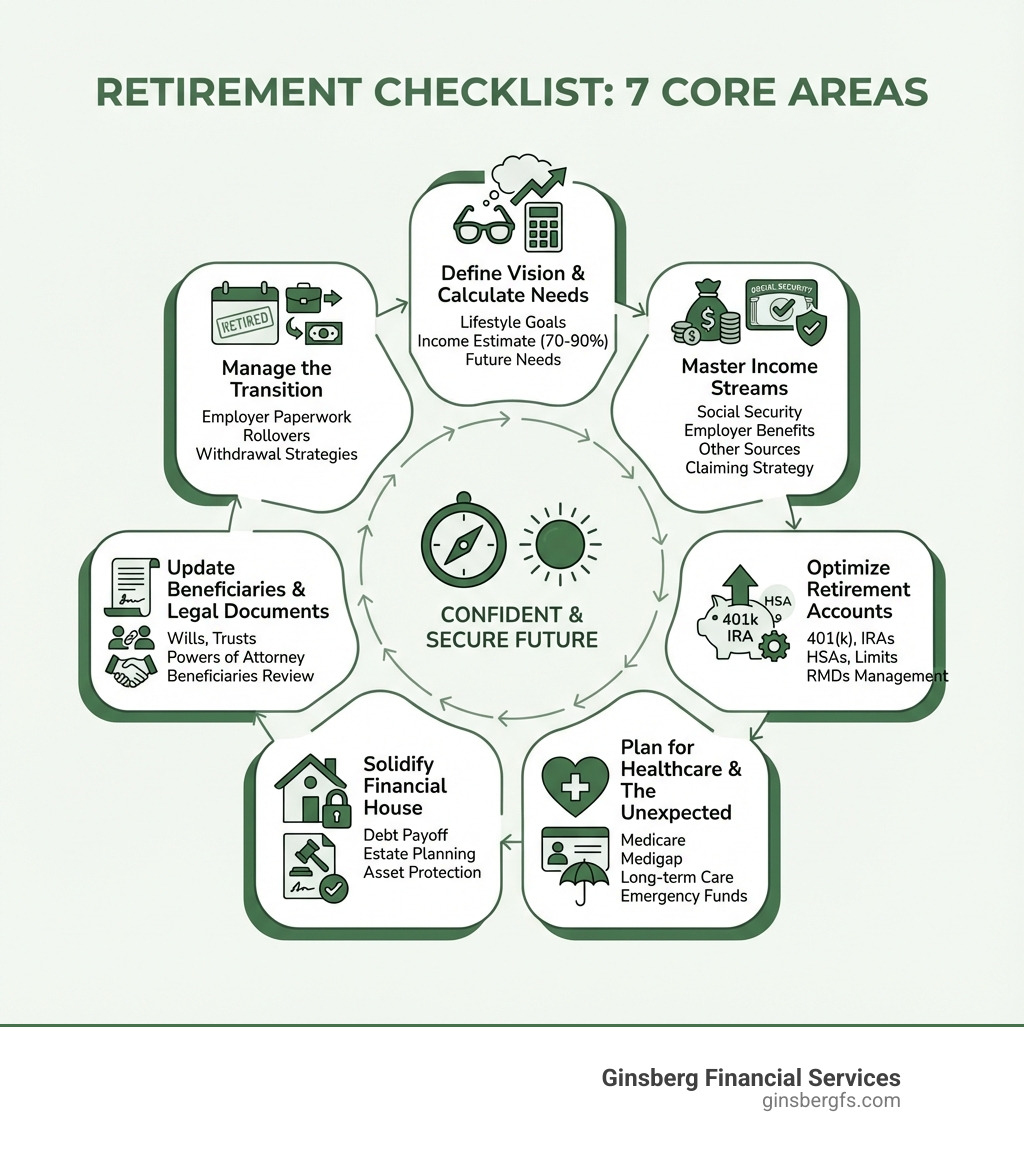
The Ultimate Preparing for Retirement Checklist: 7 Core Areas
Breaking down your preparing for retirement checklist into manageable areas makes the journey much clearer. We’re here to guide you through each essential step for a secure retirement in Walnut Creek, CA, and the wider East Bay.
1. Define Your Retirement Vision & 2. Calculate Your Needs
Before diving into numbers, envision your ideal retirement. Do you see yourself traveling, pursuing hobbies, or enjoying time with family in the East Bay? This vision dictates your financial needs.

We can then separate your “Needs” (essentials like housing and healthcare), “Wants” (dining out, travel), and “Wishes” (big dreams like a second home). This helps build a flexible plan. For a deeper look, use our Need, Wants, Wishes Calculator.
A common guideline is to replace 70-90% of your pre-retirement income. However, we must also account for longevity (your retirement could last 30+ years), rising healthcare costs, and inflation, which erodes your purchasing power. Your income plan must be built to withstand these factors. For a fresh perspective, explore how to Reimagine Your Retirement.
3. Master Your Income Streams
Optimizing your income streams is a cornerstone of the preparing for retirement checklist. This primarily involves Social Security and employer-sponsored plans.
The age you claim Social Security significantly impacts your monthly payout. Claiming at 62 results in a permanent reduction, while waiting until 70 results in a permanent increase. Your Full Retirement Age (FRA), between 66 and 67 depending on your birth year, is the baseline for 100% of your benefit. This decision also affects spousal and survivor benefits, making it a complex choice based on health, other income, and family needs.
| Claiming Age | Impact on Monthly Benefit (vs. FRA) |
|---|---|
| Age 62 | Permanently reduced (up to 30%) |
| Full Retirement Age (FRA) | 100% of earned benefit |
| Age 70 | Permanently increased (up to 32%) |
Note: Percentages are approximate.
Beyond Social Security, understand your employer benefits like 401(k)s and pensions (such as CalPERS for California public employees). Always contribute enough to get the full employer match—it’s free money. For more details, visit the Social Security Administration website and explore our Retirement Income Planning case study.
4. Optimize Your Retirement Accounts: A Complete Preparing for Retirement Checklist
This part of the preparing for retirement checklist focuses on the accounts holding your savings. Optimizing them means understanding their rules to maximize growth.
- 401(k)s and 403(b)s: Employer-sponsored plans allowing pre-tax (or Roth) contributions. For 2025, the limit is $23,500, plus a $7,500 catch-up contribution if you’re 50 or older.
- Traditional & Roth IRAs: Individual accounts for tax-advantaged savings. For 2024, the limit is $7,000, plus a $1,000 catch-up for those 50+.
- Health Savings Accounts (HSAs): A powerful tool with a “triple tax advantage.” For 2025, limits are $4,300 for individuals and $8,550 for families, plus a $1,000 catch-up for those 55+.
Finally, plan for Required Minimum Distributions (RMDs), which typically begin at age 73 from traditional retirement accounts. These mandatory, taxable withdrawals have steep penalties if missed. For official tax details, visit the IRS website, and for more on savings strategies, see our Retirement Planning resources.
5. Plan for Healthcare & The Unexpected
Healthcare is a major, unpredictable expense in retirement. Most Americans become eligible for Medicare at 65. It’s crucial to understand its parts:
- Part A (Hospital Insurance): Covers inpatient hospital care.
- Part B (Medical Insurance): Covers doctor visits and outpatient care.
- Part D (Prescription Drugs): Helps cover medication costs.
Your Initial Enrollment Period is a 7-month window around your 65th birthday. Missing it can lead to lifelong penalties. Medigap policies are private plans that help cover out-of-pocket costs. The best time to buy one is during your 6-month open enrollment period, which starts when you’re 65 and enrolled in Part B.
We must also plan for long-term care, as Medicare generally doesn’t cover it. Lastly, prepare for the unexpected by building a robust emergency fund. For official information, visit the Medicare site.
6. Solidify Your Financial House: Debt & Estate Planning
A strong financial house is key to a confident retirement. This part of the preparing for retirement checklist focuses on debt and your legacy.
Entering retirement debt-free provides significant peace of mind. If you can’t eliminate all debt, create a clear plan to manage it. A paid-off home reduces fixed expenses and frees up reliable income.
An up-to-date estate plan is non-negotiable. Key documents include:
- Wills and Trusts: Specify how your assets will be distributed.
- Beneficiary Designations: Retirement accounts and life insurance policies have beneficiaries that override your will. Review them regularly.
- Powers of Attorney: Designate someone to make financial and healthcare decisions if you become incapacitated.
For answers to common questions, see our FAQs.
7. Manage the Transition: Your Final Preparing for Retirement Checklist
The final stage is managing the actual transition. This is an event with specific, often irreversible steps.
First, finalize employer paperwork, including your departure date and termination of benefits. Next, make 401(k) rollover decisions. Rolling funds into an IRA often provides more investment choices and simplifies management.
Then, you need a tax-efficient withdrawal strategy. While the “4% rule” is a common starting point, a personalized plan is best for creating reliable income that lasts.
Finally, managing finances in early retirement requires adjustment. Stick to your budget and monitor your plan, especially during the more active initial years. For more on creating a stable income stream, review our case study on Securing Lifetime Retirement Income.
Secure Your Future with a Lifetime Wealth Blueprint

Navigating this comprehensive preparing for retirement checklist can feel monumental. A misstep in one area can impact your entire financial plan, which is why a dynamic, personalized strategy is so important.
A financial advisor can help you interpret complex rules, avoid costly mistakes, and develop a plan that aligns with your unique vision. At Ginsberg Financial Services, we help clients in Walnut Creek, CA, and the East Bay achieve retirement confidence. We move beyond conventional solutions to offer a simple roadmap designed to generate reliable, stable income and protect your portfolio from market volatility.
Our Lifetime Wealth Blueprint™ is built on the philosophy that your retirement income should be predictable and stress-free. Are you ready to transform your checklist into a living plan that secures your future? Let us help you build a blueprint for the confidence and peace of mind you deserve. Learn more by visiting our Lifetime Wealth Blueprint page.