


The Big Question: Must You Pay Taxes on Social Security Benefits?

Social security tax implications can significantly affect your retirement income. Many retirees are surprised to learn their benefits may be taxable, but understanding the rules is the first step toward effective tax planning.
Quick Answer: Will You Pay Taxes on Social Security?
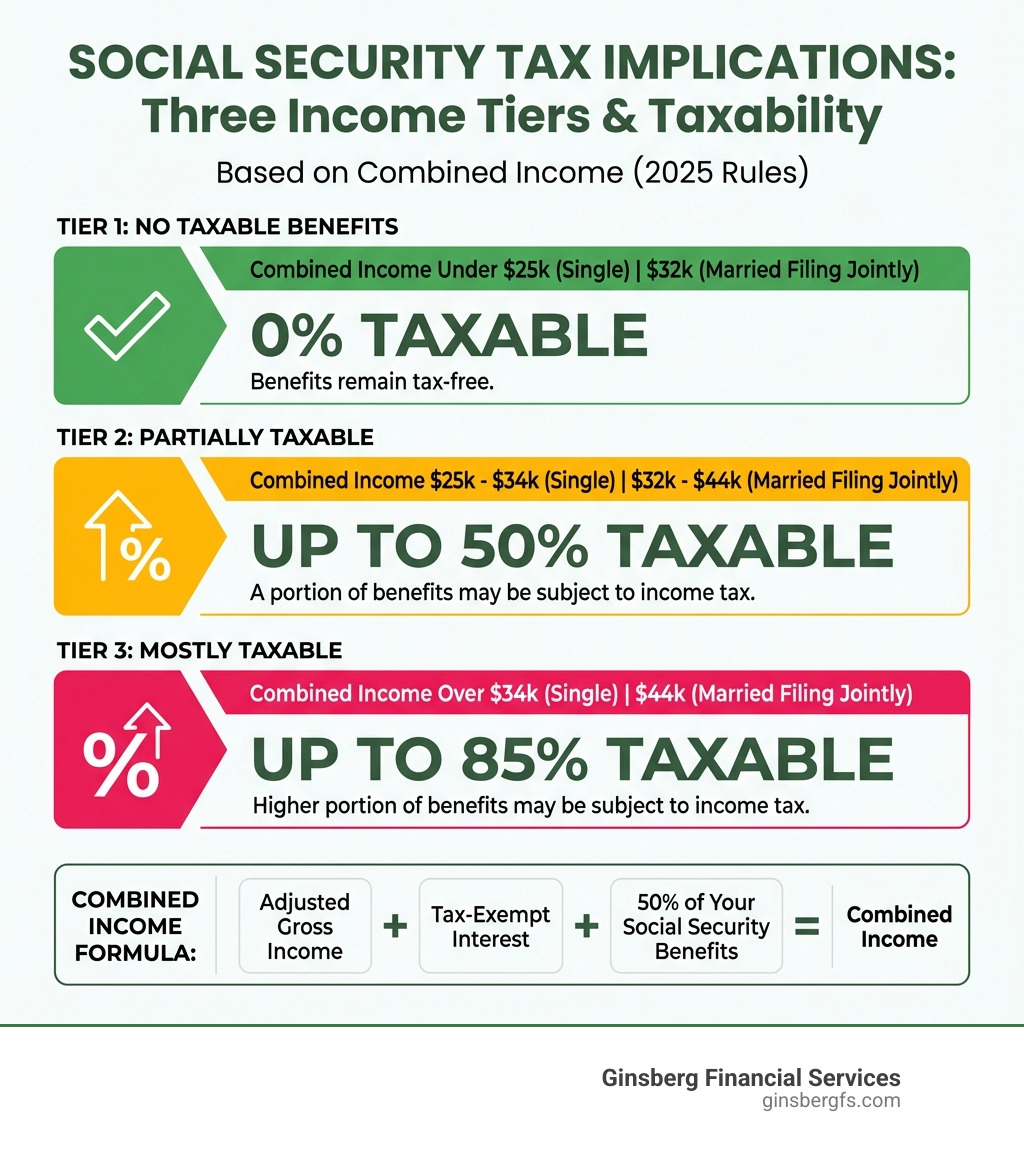
- No tax if your combined income is under $25,000 (single) or $32,000 (married filing jointly)
- Up to 50% taxable if your combined income is $25,000-$34,000 (single) or $32,000-$44,000 (married filing jointly)
- Up to 85% taxable if your combined income exceeds $34,000 (single) or $44,000 (married filing jointly)
Combined Income Formula:
Adjusted Gross Income + Tax-Exempt Interest + Half of Your Social Security Benefits = Combined Income
Navigating retirement finances can feel overwhelming, but with proper planning, most retirees can minimize or even eliminate their tax burden on Social Security benefits.
I’m Michael Ginsberg, JD, CFP®, founder of Ginsberg Financial Strategies. For over 25 years, I’ve helped clients steer complex retirement scenarios, including social security tax implications. My Lifetime Wealth Blueprint™ is designed to help retirees protect their income, reduce tax exposure, and build confidence in their financial future.
Understanding the intricate web of Social Security taxation is a cornerstone of sound retirement planning. Many assume their Social Security benefits are entirely tax-free, but for a significant portion of beneficiaries, that’s simply not the case. The taxability of your benefits hinges on a calculation known as “combined income,” your filing status, and other income sources. Let’s dig into how this works and what it means for your financial future.
Calculating Your ‘Combined Income’ to Determine Taxability
To determine your social security tax implications, you must first calculate your “combined income.” This is a specific figure the IRS uses, calculated as follows:
Adjusted Gross Income (AGI) + Tax-Exempt Interest + One-Half of Your Social Security Benefits = Combined Income
- Adjusted Gross Income (AGI): Includes wages, pensions, IRA/401(k) withdrawals, capital gains, and other taxable income, minus certain deductions.
- Tax-Exempt Interest: Interest from sources like municipal bonds.
- One-Half of Your Social Security Benefits: 50% of the total benefits you received for the year.
Once calculated, your combined income is compared against IRS thresholds based on your filing status.
Income Thresholds for Taxing Social Security Benefits
The amount of your benefits subject to tax depends on your combined income and filing status. The 50% and 85% figures refer to the maximum portion of your benefits that can be included in your taxable income, not the tax rate itself.
| Filing Status | Combined Income Threshold | Percentage of Benefits Taxable |
|---|---|---|
| Single, Head of Household, Qualifying Widow(er) | Less than $25,000 | 0% |
| $25,000 to $34,000 | Up to 50% | |
| More than $34,000 | Up to 85% | |
| Married Filing Jointly | Less than $32,000 | 0% |
| $32,000 to $44,000 | Up to 50% | |
| More than $44,000 | Up to 85% | |
| Married Filing Separately | Lived with spouse: Any income | Up to 85% |
| Lived apart all year: Same as Single | Up to 50% or 85% |
Note for those Married Filing Separately: If you lived with your spouse at any point during the year, up to 85% of your benefits are likely taxable, regardless of income. This filing status often results in higher taxes on Social Security.
Federal Tax Rates and Withholding Options
If your benefits are taxable, that taxable portion is added to your other income and taxed at your regular federal income tax rate. To manage this liability and avoid a surprise tax bill, you have a few options:
- Voluntary Withholding: You can ask the Social Security Administration (SSA) to withhold federal taxes from your monthly payments. Use Form W-4V, Voluntary Withholding Request, to choose a withholding rate of 7%, 10%, 12%, or 22%. This can also be managed online through your my Social Security account.
- Estimated Tax Payments: If you have other significant income (from investments, pensions, etc.), you may need to make quarterly estimated tax payments to the IRS to cover your total tax liability.
Proactively managing your tax payments helps prevent underpayment penalties. For more detailed information on managing your retirement income and tax planning, consider exploring our resources on Retirement Income Planning. The IRS also provides helpful guidance on taxable benefits.
How Social Security is Financed and Who Pays
Social Security is a self-funded program, financed primarily through dedicated payroll taxes (FICA and SECA) paid by employees, employers, and the self-employed.
Your eligibility for benefits is based on a system of “work credits” earned while paying into the system. Most people need 40 credits (about 10 years of work) to qualify for retirement benefits.
It’s also important to distinguish between Social Security benefits and Supplemental Security Income (SSI). SSI payments are not taxable. SSI is a separate, needs-based program and is not funded by Social Security taxes.
For more information on the intricate details of Social Security financing and our comprehensive financial planning services, please visit How Social Security is Financed and explore our Services.
Navigating Social Security Tax Implications for Expats
For U.S. citizens living abroad, social security tax implications remain a key concern. The U.S. taxes its citizens on worldwide income, meaning your Social Security benefits are subject to the same tax rules regardless of where you live. The combined income thresholds discussed earlier still apply.
To avoid double taxation (being taxed by both the U.S. and your country of residence), several mechanisms are in place:
- Tax Treaties: The U.S. has tax treaties with many countries that coordinate tax rules and prevent double taxation on income, including Social Security.
- Foreign Tax Credit (FTC): This allows you to claim a credit on your U.S. tax return for income taxes paid to a foreign country, which can significantly reduce or eliminate your U.S. tax liability on that income.
- Totalization Agreements: These agreements, like the one with Canada, help individuals who have worked in both countries qualify for benefits and avoid paying social security taxes to both countries on the same earnings. For details on the U.S.-Canada agreement, see the official pamphlet.
U.S. expats also have specific reporting requirements, such as the Foreign Bank Account Report (FBAR) and the Foreign Account Tax Compliance Act (FATCA), for their foreign financial assets. Navigating these rules requires careful planning.
The Impact of Work and Other Income on Your Benefits
Your other income sources don’t just affect the taxability of your benefits; they can also impact the benefit amount itself if you haven’t reached full retirement age (FRA).
Working While Receiving Benefits (Before FRA)
If you work and receive benefits before your FRA, your benefits may be temporarily reduced if your earnings exceed certain limits.
For 2025:
- If you are under FRA for the entire year: The earnings limit is $23,400. The SSA withholds $1 in benefits for every $2 you earn above this limit.
- In the year you reach FRA: The limit is $62,160. The SSA withholds $1 for every $3 earned above the limit, but only counts earnings before the month you reach FRA.
Once you reach FRA, these earnings limits no longer apply. Any withheld benefits are not lost; they are credited back to you through higher monthly payments later.
How Other Retirement Income Affects Taxability
Withdrawals from traditional 401(k)s, IRAs, and most pensions are taxable income. This income increases your AGI, which in turn raises your “combined income.” A higher combined income can easily push you into a higher taxability tier for your Social Security benefits. Required Minimum Distributions (RMDs), which start at age 73, can have a significant impact.
Strategic planning of when and how you draw from different retirement accounts is crucial for managing your overall tax burden. For strategies on ensuring stable income throughout retirement, explore our insights on Securing Lifetime Retirement Income.
State-Level Social Security Tax Implications
In addition to federal taxes, you must also consider state-level social security tax implications. While some states tax Social Security benefits, others do not.
Does California Tax Social Security Benefits?
For residents of Walnut Creek, East Bay, and throughout California, there is good news: California does not tax Social Security benefits. This is a significant advantage for retirees in the state, as your Social Security income is entirely exempt from California state income tax.
This simplifies retirement planning for Californians, but it’s crucial to understand the rules if you plan to move to another state in retirement. Understanding these state-specific nuances is a vital part of comprehensive Retirement Planning.
Take Control of Your Retirement Taxes

Navigating the complexities of social security tax implications might seem daunting, but with the right knowledge and strategic planning, you can significantly reduce your tax burden and achieve greater financial peace of mind in retirement. Whether you’re planning for your future in California or considering life abroad, understanding how your Social Security benefits interact with other income sources and tax laws is paramount.
At Ginsberg Financial Services, we believe that retirement should be an exciting and confident chapter, not one filled with tax worries. Our mission is to help you generate reliable, stable income and protect your hard-earned savings from market volatility and unexpected tax hits. We specialize in providing a simple, non-conventional roadmap to secure retirement for individuals in Walnut Creek, East Bay, and throughout California.
Don’t let uncertainty about your social security tax implications dampen your retirement dreams. Take control of your financial future by developing a robust tax planning strategy that aligns with your goals. We’re here to help you understand every facet of your retirement income, from federal and state taxes to international considerations for expats.
Ready to build a retirement plan that protects your income and minimizes taxes? It’s time to explore how our expertise can benefit you. Build your Lifetime Wealth Blueprint with us today and gain the confidence you deserve. If you have more questions, check out our FAQs or reach out to our team.