

Market Volatility Strategies Survival Guide
Why Market Volatility Strategies Are Essential for Your Financial Security
Investing in today’s volatile market can feel like a gamble. Rapid price fluctuations can trigger panic and lead to poor decision-making, especially for those looking to safeguard their hard-earned wealth. When market swings happen unpredictably, many investors struggle to stay on track with their financial goals, making it even more critical to have effective market volatility strategies in place.
Market volatility isn’t just a nuisance; it can directly impact your bottom line. When the market moves quickly, those unprepared or reacting emotionally are at risk of making costly mistakes. For example, panic-selling during a downturn locks in losses, and without a clear strategy, the inevitable recovery might pass you by. Many investors lose sleep over the stress of these swings, wondering whether they’ve missed opportunities or are doomed to take a hit.
To navigate market volatility, having a disciplined, long-term strategy is essential. At Ginsberg Financial Strategies, we offer the Lifetime Wealth Blueprint℠, a comprehensive roadmap that helps you stay on course, even when the market is unpredictable. By combining strategies like diversification, tax-aware planning, and risk management tools, we protect your investments while also allowing for growth. This ensures that your financial plan can weather the ups and downs, giving you confidence through every market shift.
At Ginsberg Financial Strategies, our approach to market volatility strategies centers on helping investors protect long-term goals without losing sight of growth, income, and flexibility. Through the Lifetime Wealth Blueprint℠, we focus on core volatility-management strategies such as diversification, thoughtful asset allocation, disciplined investing, tax-aware planning, and risk management tools designed to support greater stability when markets get rough.
Key Market Volatility Strategies:
- Diversification – Spreading investments across various asset classes to reduce risk.
- Dollar-Cost Averaging (DCA) – Investing fixed amounts at regular intervals, regardless of market conditions.
- Tax-Loss Harvesting – Selling losing investments to offset gains and lower your tax bill.
- Risk Assessment – Regularly reviewing your risk tolerance and time horizon.
- Professional Guidance – Working with a financial advisor for a personalized plan.
What is Market Volatility and Why Does it Matter?
Market volatility is the market’s heartbeat – sometimes calm, other times racing. Formally, it’s the speed of price changes in financial markets, often measured by standard deviation. Higher volatility generally means higher risk.
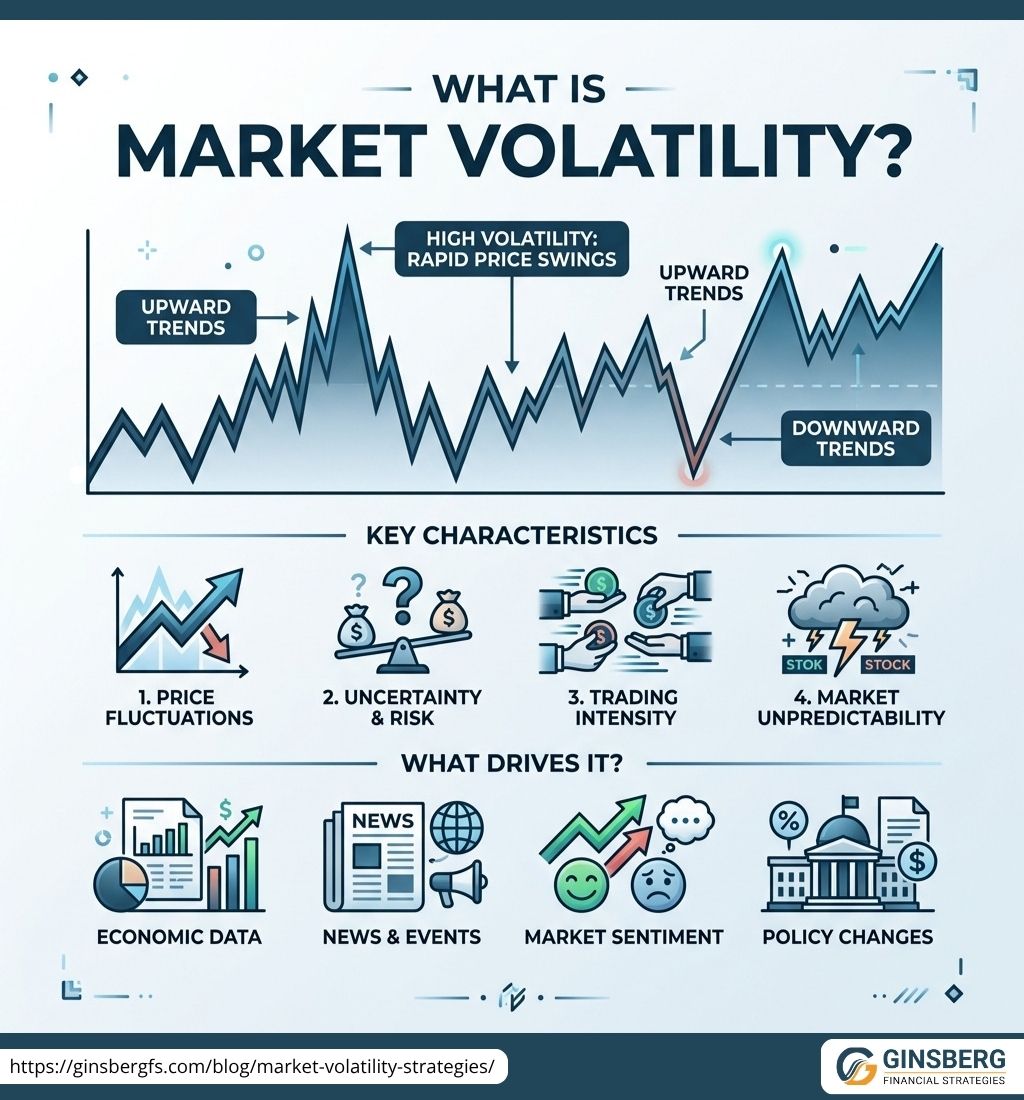
Why is it constant? Financial markets are dynamic, influenced by economic data, geopolitical events, corporate earnings, and human emotions. This creates constant price movement. As one expert noted, price movement is necessary to make money in the markets; volatility is simply how rapidly those prices move.
Volatility presents both risks and opportunities. High volatility can lead to significant losses in a short period, which is unsettling for investors, especially those near retirement. However, for those with sound market volatility strategies, it can also present opportunities for quicker gains. The key is to manage it for your benefit while minimizing risks.
Investor sentiment is a major driver. The Cboe Volatility Index (VIX), or “fear gauge,” measures expected short-term price changes in the S&P 500. A VIX below 20 suggests low volatility, while 30+ signals high volatility. The VIX and similar global indexes often rise when stock markets fall, as seen in 2008 when major volatility indexes surged over 50%.
A Comprehensive Guide to Market Volatility Strategies
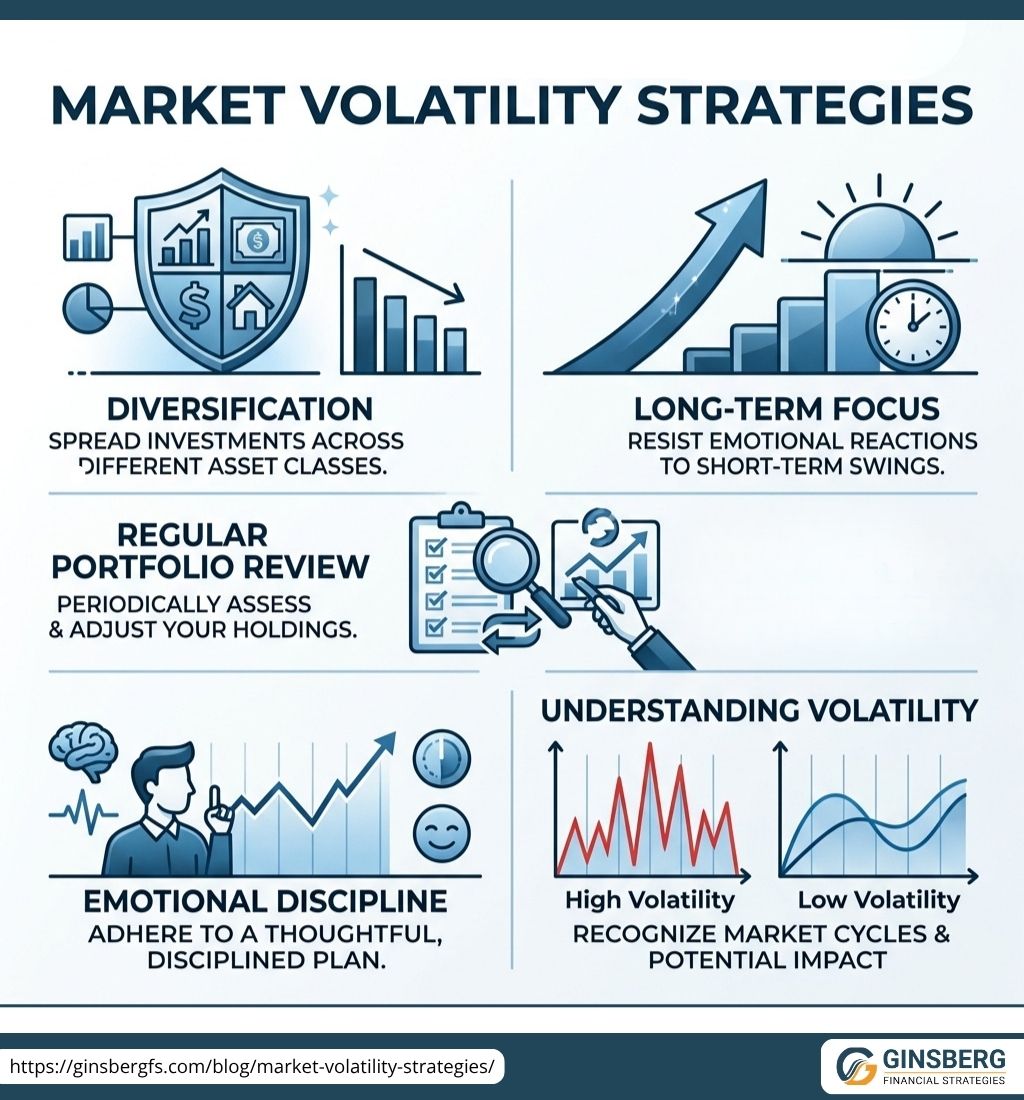
Handling market swings starts with a clear plan. At Ginsberg Financial Strategies, we focus on thoughtful, long-term market volatility strategies designed to help you respond with discipline instead of emotion.
The Foundation: Your Financial Plan and Risk Assessment
A robust financial plan is the cornerstone of managing market volatility. Our Lifetime Wealth Blueprint℠ serves as this foundation, providing clarity on your objectives and anticipating market swings to keep your strategy resilient. It helps you avoid costly emotional mistakes by staying aligned with your long-term goals.
Regularly reassessing your risk tolerance is paramount. Are you willing to accept temporary losses for higher long-term returns, or do downturns make you nervous? If you’re losing sleep, you may have too much risk. Your time horizon is also key; investors nearing retirement should prioritize downside protection, while those with decades to go can ride out challenging periods.
Bolstering your emergency fund is another critical defense. While 3-6 months of income is standard, we may recommend 6-9 months or more if your income fluctuates. This cushion prevents you from being forced to sell investments at a loss during a downturn. Our Lifetime Wealth Blueprint℠ framework helps build this resilience.

Core Defensive Tactic: Diversification and Asset Allocation
Diversification is a powerful shield against market volatility. It means spreading investments across various asset classes, industries, and geographies so that if one area experiences a downturn, others may perform well, smoothing out your returns.
A diversified portfolio aligns with your risk tolerance and typically spans three categories:
- Stocks (Equities): Offer higher growth potential but more volatility. Diversify by owning large, mid, and small-cap domestic companies, plus international equities.
- Bonds (Fixed Income): Generally provide more stability. High-quality bonds can act as a ballast during stock market turbulence, though they are subject to interest rate and credit risks.
- Cash and Cash Equivalents: Offer liquidity and stability with lower returns.
Modern Portfolio Theory (MPT) provides the academic basis for this strategy. It shows how combining different assets can create an optimal portfolio that maximizes return for a given level of risk. While diversification doesn’t guarantee profits or prevent losses, it is crucial for managing risk.
At Ginsberg Financial Strategies, we also explore options like guaranteed annuities, which can provide reliable income and lower overall portfolio volatility. Our Lifetime Wealth Blueprint℠ incorporates strategic diversification customized to your needs, helping you achieve stability in turbulent markets.
Proactive Market Volatility Strategies: DCA and Tax-Loss Harvesting
Beyond a strong foundation, you can employ proactive market volatility strategies to steer turbulent times.
1. Dollar-Cost Averaging (DCA): This strategy involves investing a fixed amount at regular intervals. DCA mitigates short-term volatility risk by removing the pressure to time the market. When prices are high, you buy fewer shares; when prices are low, you buy more. This averages out your purchase price over time. It’s a simple, disciplined approach that removes emotion from investing.
2. Tax-Loss Harvesting: This strategy turns market losses into tax savings. It involves selling investments in a taxable account that have lost value. The losses can then offset capital gains, and if losses exceed gains, you can deduct up to $3,000 against your ordinary income. The main caveat is the IRS “wash-sale rule,” which disallows the loss if you buy a “substantially identical” security within 30 days. A professional can help steer this rule to optimize your after-tax returns.
Advanced Hedging: An Introduction to Risk Management Tools
Advanced hedging strategies can serve as powerful risk management tools, acting like insurance for your investments. They involve making investments designed to offset potential losses in your primary holdings.
While you can’t invest directly in the VIX, you can gain exposure through complex instruments like VIX-related ETFs, options, and futures. However, these carry significant risks:
- VIX-linked products are based on futures contracts, and their performance can differ from the VIX index due to technical factors that can erode long-term returns.
- Options, such as puts, can act as insurance by gaining value when an asset’s price falls. However, they are high-risk, unsuitable for many investors, and involve costs and time decay that can lead to a total loss of the investment.
Hedging strategies incur costs and do not guarantee profits. They are best suited for experienced investors with short-term goals. For our clients in Walnut Creek and the East Bay, a more appropriate approach within our Lifetime Wealth Blueprint℠ involves strategic asset allocation, including guaranteed annuities, to provide stability without the complexities of speculative hedging.
The Psychological Edge: Mastering Your Investor Mindset
A challenge of market volatility is not the market, but our reaction to it. Emotional decisions—driven by fear or greed—can derail the best financial plans. Panic selling locks in losses and prevents you from participating in the eventual rebound.
Maintaining a long-term perspective is key. History shows that markets recover. Sticking to your plan, especially when your gut tells you otherwise, is a powerful market volatility strategy. Our Lifetime Wealth Blueprint℠ is designed as a behavioral guide, helping clients stay disciplined by focusing on what truly matters: your long-term financial security and reliable retirement income.
When to Seek Help: Professional Guidance and Custom Solutions
Knowing when to seek professional guidance is crucial. The financial landscape is complex, and during volatile periods, ensuring your strategy aligns with your goals can be overwhelming.

That’s where Ginsberg Financial Strategies comes in. We provide the clarity and confidence you need, whether you’re anxious about market swings or want a second opinion. Our team specializes in helping individuals achieve retirement confidence by generating stable income and protecting portfolios from market volatility.
Our Lifetime Wealth Blueprint℠ offers a personalized roadmap to reduce your exposure to market volatility. This includes addressing critical concerns like Sequence of Returns Risk, which can significantly impact retirement portfolios. By working with us, you gain a partner dedicated to helping you build a resilient portfolio and a clear Retirement Income Roadmap. We serve clients in Walnut Creek and the wider East Bay area with custom solutions to steer market challenges.
Conclusion: Building Your Resilient Financial Future
Market volatility is an inherent part of investing, but it doesn’t have to be a source of constant stress. By implementing sound market volatility strategies, you can protect your portfolio, potentially capitalize on opportunities, and maintain your peace of mind.
We’ve explored key strategies: building a strong financial plan and assessing your risk, diversifying across and within asset classes, utilizing dollar-cost averaging and tax-loss harvesting, understanding advanced hedging tools, and most importantly, mastering your investor mindset. Discipline and patience are your greatest allies. Volatility is normal; focusing on your long-term goals is what truly matters.
At Ginsberg Financial Strategies, we are committed to helping you build a resilient financial future. Our Lifetime Wealth Blueprint℠ is specifically designed to provide a simple, non-conventional roadmap to secure retirement, guiding you through market ups and downs with confidence. Don’t let market volatility derail your retirement dreams. Reach out to us today to get started on securing your financial future.
Build your financial future with our Lifetime Wealth Blueprint℠