


A Comprehensive Guide to Tax-Efficient Retirement

Tax Efficient Retirement: Maximize Savings 2026
Why Your Withdrawal Strategy Matters More Than You Think
Tax efficient retirement planning isn’t just about how much you save—it’s about how much you keep after taxes. The difference between a strategic withdrawal plan and simply pulling money when you need it can cost you tens of thousands of dollars over the course of your retirement.
Here’s what tax-efficient retirement means for you:
- Minimize taxes on your retirement income by withdrawing from the right accounts at the right time
- Maximize your after-tax income so your savings last longer and support the lifestyle you’ve worked hard to achieve
- Steer the three tax buckets (tax-deferred, tax-free, and taxable) to keep more money in your pocket
- Avoid costly pitfalls like the OAS clawback, IRMAA surcharges, and unnecessary RMD penalties
- Coordinate Social Security, pensions, and investment withdrawals to stay in lower tax brackets
The research is clear: retirees who implement a tax-efficient withdrawal strategy can extend the life of their portfolio by years and leave a larger legacy for their heirs. Yet many people underestimate the impact of taxes on their retirement income, focusing solely on accumulation rather than smart distribution.
As the saying goes: “It’s not what you earn, it’s what you keep.”
I’m Michael Ginsberg, JD, CFP®, and over my 25+ years in financial planning, I’ve helped countless clients implement tax-efficient retirement strategies through my proprietary Lifetime Wealth Blueprint, which focuses on generating reliable income while minimizing tax drag and market risk. My approach integrates withdrawal sequencing, Roth conversions, asset location, and proactive tax management into a cohesive plan designed to protect what you’ve built and make your money last as long as you need it to.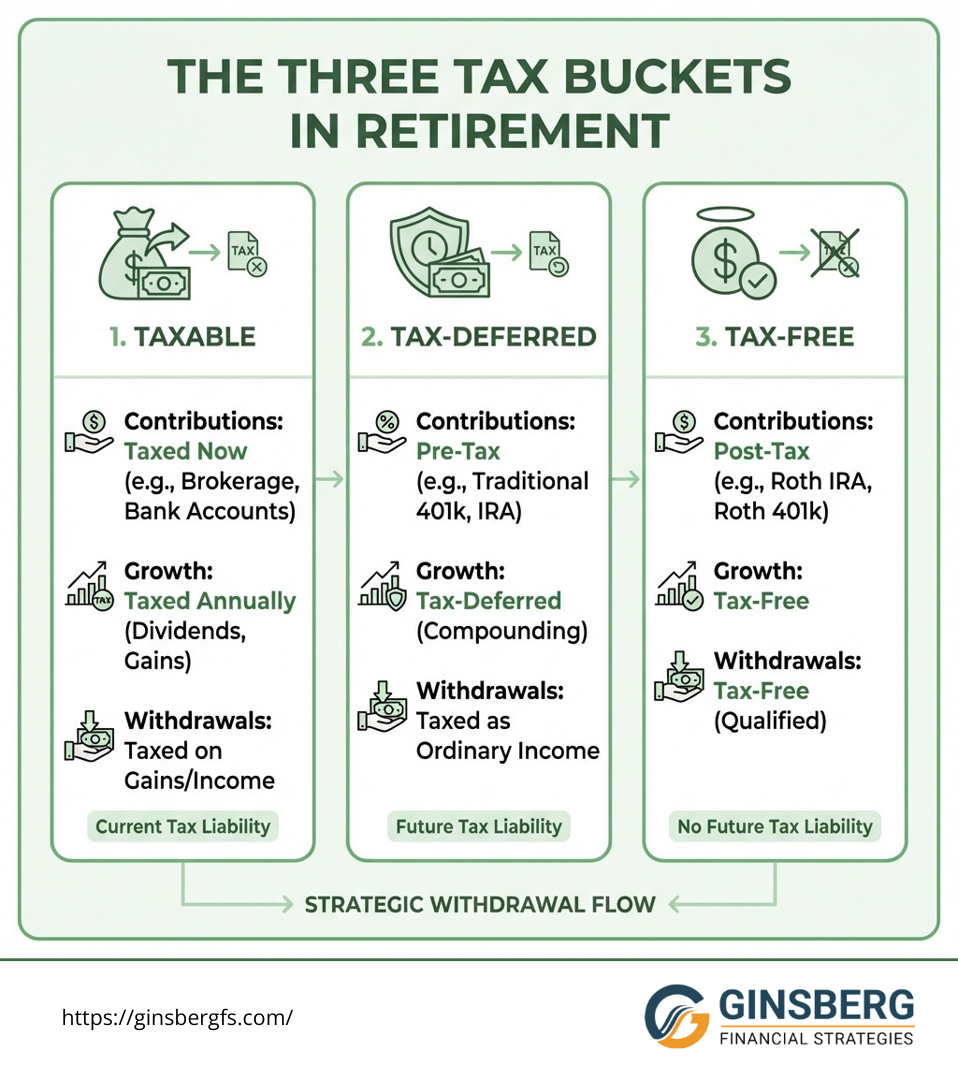
Tax efficient retirement terms at a glance:
Core Strategies for a Tax-Efficient Retirement
Achieving a truly tax efficient retirement requires understanding the different ways your income sources are taxed. It’s not a one-size-fits-all solution; rather, it’s about strategically managing your diverse financial assets to minimize your tax burden.
The Three Buckets: How Your Retirement Income is Taxed
Think of your retirement savings as living in three distinct “buckets,” each with its own tax rules. Understanding these rules is the foundation of any successful tax efficient retirement strategy.
- Tax-Deferred Accounts (e.g., 401(k), Traditional IRA): You contribute pre-tax dollars, reducing your current taxable income, and investments grow tax-deferred. In retirement, all withdrawals are taxed as ordinary income. The IRS mandates withdrawals through Required Minimum Distributions (RMDs), typically starting at age 73.
- Tax-Free Accounts (e.g., Roth IRA, Roth 401(k), HSA): You contribute after-tax dollars, so there’s no upfront deduction. However, investments grow tax-free, and qualified withdrawals in retirement are completely tax-free. Health Savings Accounts (HSAs) are also a powerful tool, offering a triple tax advantage (tax-deductible contributions, tax-free growth, and tax-free withdrawals for medical expenses) and can serve as a supplemental tax-free retirement account.
- Taxable Accounts (e.g., Brokerage Accounts, Savings Accounts): These standard brokerage accounts are funded with after-tax money. You pay taxes annually on dividends, interest, and realized capital gains. The advantage is that long-term capital gains are taxed at lower rates (0%, 15%, or 20%). They also offer a “step-up in basis” for heirs, which can eliminate capital gains taxes on inherited assets.
Other Retirement Income Sources:
- Social Security Benefits: Depending on your “provisional income,” up to 85% of your Social Security benefits can be subject to federal income tax. Managing your other income streams is key to reducing the taxability of your benefits.
- Pensions & Annuities: Generally, the taxable portion of payments from qualified pension plans and annuities are taxed as ordinary income. If you contributed after-tax dollars to your pension, a portion of each payment may be tax-free.
Within our Lifetime Wealth Blueprint, we help you categorize and understand the tax implications of every dollar you’ve saved, ensuring you have a clear picture of your income landscape in retirement.
The Art of Withdrawal: Sequencing Your Income for Tax Efficiency
Once you understand the tax characteristics of each bucket, the next step is to develop a strategic withdrawal sequence. This is where the “art” of tax efficient retirement planning truly comes into play. The goal is to control your taxable income each year, keeping you in lower tax brackets and minimizing Medicare premium surcharges (IRMAA).
There are several popular withdrawal strategies:
-
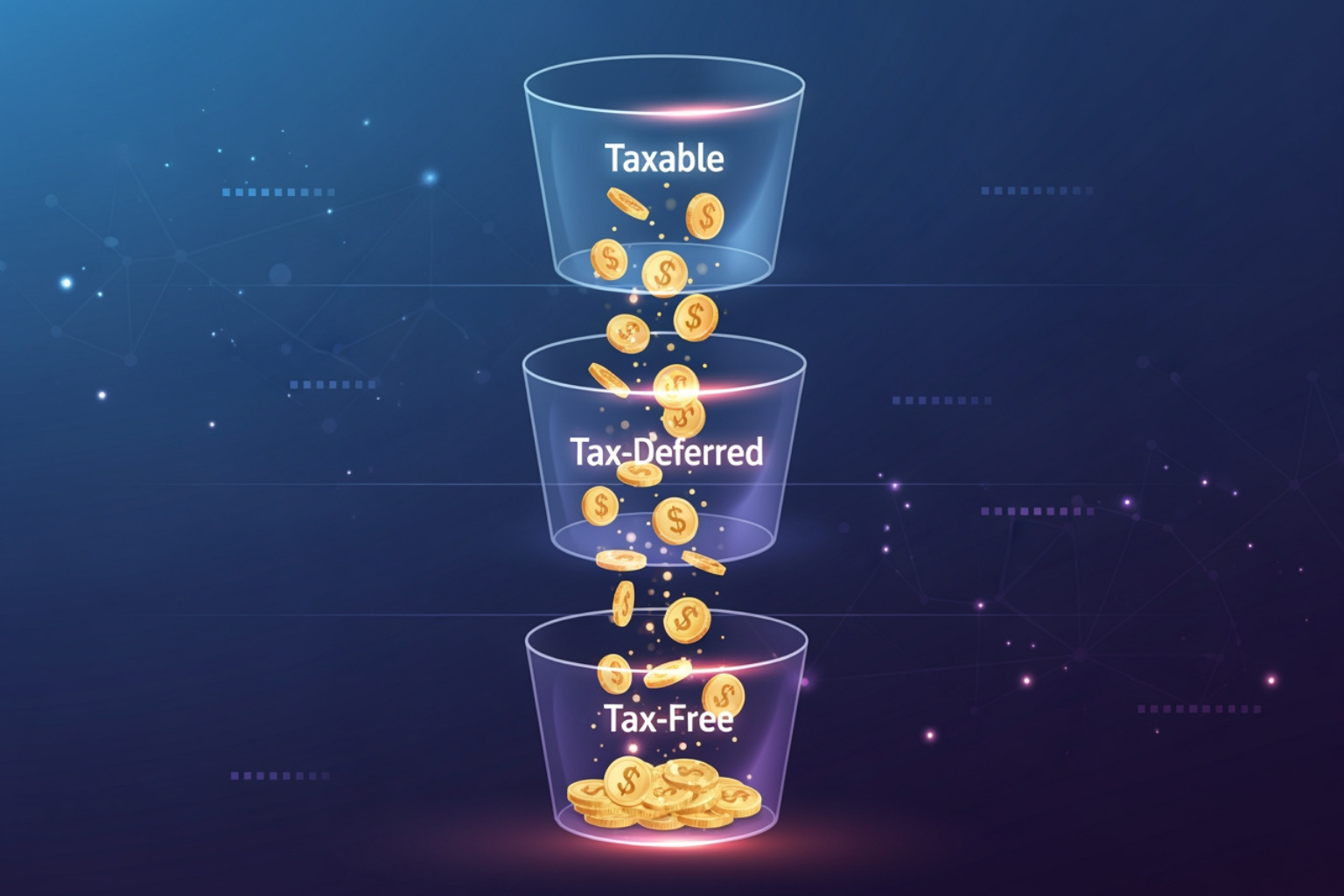
Sequential “Waterfall” Strategy: This common strategy involves spending from taxable accounts first, then tax-deferred, and finally tax-free accounts. While simple, it can lead to a large tax bill later in retirement when RMDs from your tax-deferred accounts force you into higher brackets.
-
Proportional Withdrawal Strategy: This method involves taking a proportional amount from each of the three buckets annually. It helps smooth out your taxable income from year to year but can be more complex to manage.
-
Personalized Tax-Bracket-Aware Strategy: This is our preferred approach and a cornerstone of our Lifetime Wealth Blueprint. It’s a dynamic strategy that customizes withdrawals to your situation. The goal is to keep your taxable income in a desirable tax bracket each year by strategically pulling from different accounts—for example, taking from tax-deferred accounts to “fill up” low brackets or using Roth withdrawals to supplement income without increasing your tax bill.
At Ginsberg Financial Services, we don’t believe in generic advice. Our Retirement Income Roadmap is designed to help you design a withdrawal plan that fits your specific needs. We integrate tax-savvy withdrawals into your personalized plan, ensuring every decision is made with your long-term tax efficiency in mind.
Proactive Account Management for a Tax-Efficient Retirement
Beyond withdrawal sequencing, proactive management of your retirement accounts is crucial for a truly tax efficient retirement. This involves leveraging key strategies like Roth conversions and asset location.
-
Required Minimum Distributions (RMDs): Starting at age 73, the IRS requires you to take RMDs from tax-deferred accounts. These taxable withdrawals can push you into higher tax brackets. Proactive planning, such as performing Roth conversions in earlier years or using Qualified Charitable Distributions (QCDs), can reduce the size and tax impact of future RMDs.
-
Roth Conversions: A Roth conversion moves money from a tax-deferred account to a tax-free Roth account. You pay income tax on the converted amount now to secure tax-free growth and withdrawals later. This is a powerful strategy, especially in low-income years (like early retirement before RMDs begin), to reduce future RMDs and create a source of tax-free income for yourself and your heirs.
-
Asset Location Strategy: Asset location is about placing investments in the most tax-efficient account type. A common strategy is to hold high-growth assets (like stocks) in tax-free Roth accounts, tax-inefficient assets (like bonds) in tax-deferred accounts, and tax-efficient assets (like index funds) in taxable accounts. This minimizes the tax drag on your portfolio’s growth.

Our Lifetime Wealth Blueprint incorporates these proactive management strategies to build a robust tax efficient retirement plan. We work with you to analyze your RMDs, identify optimal Roth conversion opportunities, and strategically locate your assets to maximize your after-tax wealth.
Building Your Personalized Decumulation Plan
A tax efficient retirement isn’t just about managing assets; it’s about building a comprehensive “decumulation” plan that turns your savings into sustainable, tax-optimized income throughout your golden years.
Advanced Tax-Reduction Tactics for Retirees
Even with the core strategies in place, there are advanced tactics that can further improve your tax efficient retirement.
-
Optimizing Social Security: Since up to 85% of your Social Security benefits can be taxed, managing your other income sources is critical. Strategic Roth withdrawals, for example, can provide income without increasing the provisional income that triggers this tax. The decision on when to claim benefits should also be integrated into your overall tax and withdrawal plan.
-
Managing Capital Gains: In taxable accounts, aim to hold assets for over a year to qualify for lower long-term capital gains tax rates. You may even be able to pay 0% tax on gains if your income is below a certain threshold—a strategy called tax-gain harvesting. Conversely, tax-loss harvesting involves selling investments at a loss to offset gains and up to $3,000 of ordinary income, but be mindful of the wash-sale rule.
-
Charitable Giving Strategies: For the charitably inclined, tax-smart giving strategies can lower your tax bill. A Qualified Charitable Distribution (QCD) allows individuals 70½ or older to donate directly from an IRA to charity, satisfying their RMD without the income being taxed. Donor-Advised Funds (DAFs) and Charitable Remainder Trusts (CRTs) are other powerful tools for more complex philanthropic goals.
These advanced tactics are carefully woven into your Lifetime Wealth Blueprint to provide a truly holistic and tax efficient retirement approach.
Creating Your Holistic Retirement Income Plan
A tax efficient retirement isn’t just about avoiding taxes; it’s about building a sustainable income stream that lasts your lifetime. This is where a comprehensive “decumulation plan” comes in.
- Decumulation Plan Defined: It’s your personal blueprint for drawing down your assets in a strategic, tax-optimized way. It considers all your income sources, spending needs, and tax implications year after year.
- Budgeting for Needs vs. Wants: A realistic budget that separates essential “needs” from discretionary “wants” is the foundation of a successful plan. You can even try our Need, Wants, Wishes Calculator to get started.
- Planning for Inflation & Longevity: A solid plan must account for inflation, which erodes your purchasing power over time. It also needs to plan for longevity. With Americans living longer than ever, many into their 80s and beyond, your retirement could last 20-30 years. Our plans are built to provide income for your entire life, protecting you from the risk of outliving your money.
- Mitigating Sequence of Returns Risk: This is the danger that poor market returns early in retirement can cripple your portfolio’s longevity. We mitigate this risk by diversifying income sources and managing withdrawal rates, especially during market downturns.

The Lifetime Wealth Blueprint is our comprehensive framework for integrating all these aspects—tax strategies, income generation, risk management, and budgeting—into a cohesive and dynamic plan designed specifically for you. It’s not just about accumulating wealth; it’s about intelligently preserving and distributing it.
When to Seek Professional Guidance
While this guide provides valuable insights, the nuances of tax efficient retirement planning are complex and ever-changing. Knowing when to seek professional guidance can make all the difference.
- Navigating Tax Thresholds: Understanding how your withdrawals affect various tax thresholds is critical. A small increase in income can trigger higher Medicare premiums (IRMAA) or increase the tax on your Social Security benefits. A professional can help you steer these complex interactions to avoid costly surprises.
- Complexity of Tax Laws: Tax laws are notoriously complex and subject to frequent changes. What was optimal last year might not be this year. Staying on top of these changes and understanding how they apply to your unique situation is a full-time job.
- Personalized Strategy Creation: Generic advice rarely fits. Your financial situation, goals, and even your state of residence create unique tax planning opportunities and challenges. A personalized strategy considers all these factors to create an optimal plan that generic rules of thumb simply cannot match.
- The Value of a Financial Advisor: A qualified financial advisor acts as your guide, helping you clarify goals, analyze your situation, develop a customized plan, and provide peace of mind by ensuring your plan stays on track.

At Ginsberg Financial Services, we specialize in helping individuals in Walnut Creek, CA, and across the East Bay achieve retirement confidence. Our Lifetime Wealth Blueprint is designed to simplify this complex process, generating reliable, stable income and protecting your portfolio from market volatility. We provide a clear, non-conventional roadmap to secure retirement, ensuring you can truly enjoy the fruits of your labor.
Don’t leave your tax efficient retirement to chance. Learn more about our Services and how we can help you build a financial future that’s both prosperous and protected.