


Hope Is Not a Hedge: Why Your Retirement Strategy Needs a Risk Audit

Hope Is Not a Hedge: Why Your Retirement Strategy Needs a Risk Audit
Why Your Retirement Needs a Survival Plan
Retirement risk management is the process of identifying and addressing the threats that could derail your financial security. While saving is crucial, a proactive plan to protect your assets is what truly prepares you for a successful retirement. The numbers are sobering: 82% of investors worry about a major market downturn, and for good reason.
Here are the five primary risks every retiree faces:
- Market Volatility: Stock market downturns can devastate savings, especially when you start making withdrawals.
- Inflation: Rising costs erode your purchasing power. A dozen eggs that cost $1.37 in 2004 cost $2.70 in 2024.
- Longevity: You might live longer than expected. One in three people aged 65 will live to 90.
- Healthcare Costs: Medical and long-term care expenses can quickly drain your assets.
- Sequence of Returns: Early losses have a much bigger impact than later ones. A 20% portfolio decline requires a 25% gain just to break even.
Most retirement planning focuses on accumulation, but the real challenge begins at distribution. This is when market timing, inflation, and longevity collide. This isn’t about fear; it’s about preparation.
You need a framework to protect your savings, grow them carefully, and ensure they last. I’m Michael Ginsberg, JD, CFP®, and I’ve spent over 25 years developing retirement risk management strategies. My Lifetime Wealth Blueprint™ was created to help diligent savers like you protect their assets while generating the reliable income they need.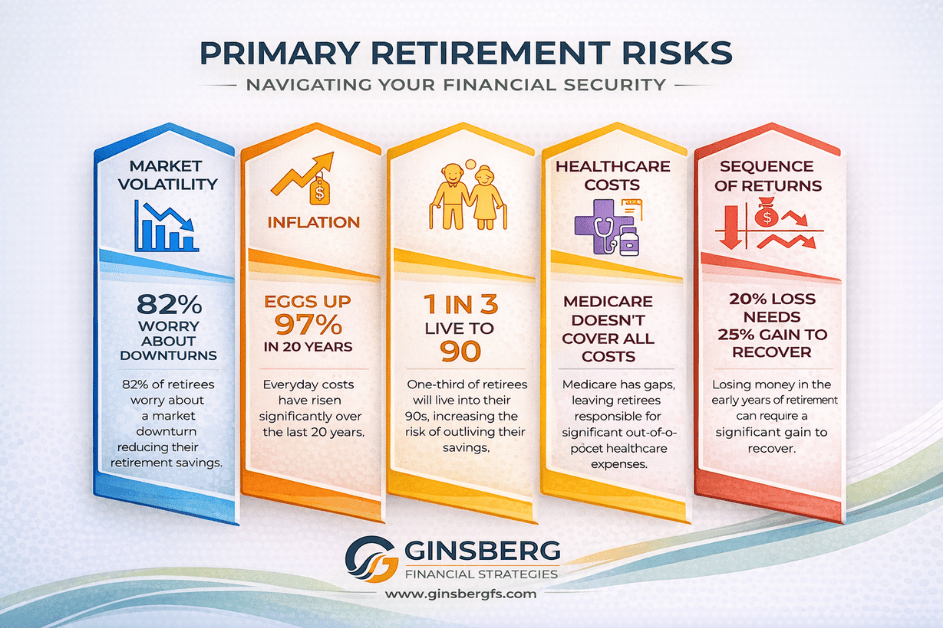
A Framework for Comprehensive Retirement Risk Management
Successfully navigating retirement demands a robust framework for retirement risk management to anticipate challenges and build resilience into your financial plan.
Identifying Core Threats: The Foundation of Retirement Risk Management
Let’s dig into the primary risks that can threaten your retirement security and how we approach mitigating them.
Market Volatility: The Unpredictable Rollercoaster
Market downturns are devastating when you’re drawing income. For example, the market turmoil in 2022 showed that even a traditional 60/40 portfolio could suffer significant losses. Despite a rebound in 2023, many balanced portfolios were still flat or down over that two-year period. This highlights a critical point: a 20% portfolio decline requires a 25% gain just to recover, a difficult hurdle when you’re also making withdrawals. For historical context on market cycles, see the Stock Market overview.
Sequence of Returns Risk: The Timing Trap
This brings us to a particularly insidious risk: Sequence of Returns Risk. It’s not your average return that matters most, but when those returns happen. Negative returns early in retirement can permanently impair your portfolio because you are forced to sell more assets at low prices to fund your lifestyle, drastically shortening the life of your savings.
Inflation Erosion: The Silent Thief
Inflation steadily erodes your purchasing power. A dozen large eggs cost $1.37 in 2004 but jumped to $2.70 by 2024—an increase of 97%. This impacts everything. Without a strategy to outpace inflation, your nest egg will feel much smaller over time. Our insights on Inflation and the Stock Market Lie shed more light on this.
Longevity Risk: Living Longer, Needing More
People are living longer, which is wonderful news but presents a financial challenge. About 1 in 3 65-year-olds today will live to at least 90. Your financial plan must be built to last for a retirement that could span several decades.
Healthcare Costs & Long-Term Care Expenses: The Unforeseen Burden
Healthcare is a major, unpredictable expense. Medicare doesn’t cover everything, such as most dental, vision, or long-term care. The need for assistance with daily living—whether at home or in a facility—is a real possibility that can quickly deplete savings. Planning for these costs is crucial, and you can explore options for Self-Funding Long-Term Care Risk. For more insights, see Four Big Retirement Risks to Consider and Prepare For.
Strategic Portfolio & Income Planning for Retirement Risk Management
Once we understand the threats, we implement strategic portfolio and income planning.

The Retirement Bucket Strategy: A Layered Approach to Risk
We often use a ‘bucket strategy’ to segment assets by time horizon and risk:
- Liquidity Bucket (1-3 Years): Holds cash or equivalents for immediate needs, so you never have to sell in a down market.
- Lifestyle Bucket (3-10 Years): Invested more conservatively for medium-term goals, used to refill the Liquidity bucket.
- Legacy Bucket (10+ Years): Invested for long-term growth, with time to recover from market swings.
This layered approach helps balance immediate income needs with long-term growth, directly addressing sequence of returns risk.
Diversification, Rebalancing, and Strategic Withdrawals
Effective retirement risk management goes beyond a traditional 60/40 portfolio. We believe in broader diversification across asset classes to mitigate risk. This is paired with disciplined portfolio rebalancing—selling high and buying low—to maintain your target risk level. How you withdraw money is just as important. A core component of our Retirement Income Roadmap is creating a flexible withdrawal strategy that can adapt to market conditions, helping your money last longer.
These elements are coordinated within our Lifetime Wealth Blueprint, which serves as the master plan linking your investment strategy, spending rules, and risk controls so they work together instead of in isolation.
Optimizing Social Security and Using Annuities
Your Social Security claiming age is a critical decision. Delaying benefits until age 70 can increase your guaranteed, inflation-adjusted lifetime income by about 8% per year after full retirement age. For many, this can cover a significant portion of retirement income. Annuities can also play a role by converting a lump sum into a guaranteed income stream, a strategy for Securing Lifetime Retirement Income and managing longevity risk.
Disciplined Spending and the Lifetime Wealth Blueprint™
A disciplined spending plan is paramount. Being prepared to reduce discretionary spending after a market downturn can protect your principal. All these elements are integrated into our Lifetime Wealth Blueprint™, a personalized and holistic roadmap designed to generate reliable income while protecting your portfolio. For more on this, see our guide to Managing Your Retirement Portfolio.
The Human Element: Finalizing Your Plan with Advice, Taxes, and Legacy
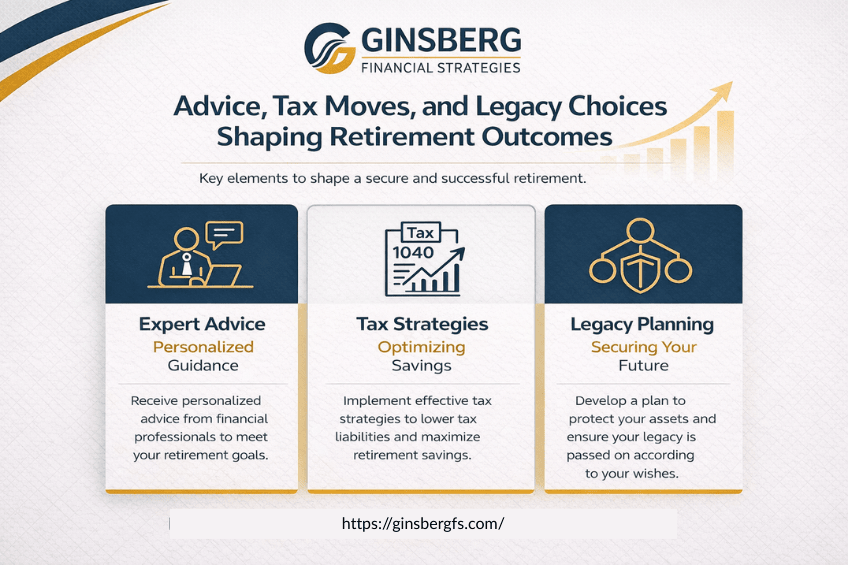
Successful retirement risk management also involves personal factors, tax planning, and your legacy.
Assessing Risk and Balancing Growth with Preservation
Your comfort with risk often changes in retirement. We help you assess your true risk tolerance to strike the right balance between growth (to beat inflation) and capital preservation (to protect your principal). The Lifetime Wealth Blueprint™ is designed to optimize your portfolio for necessary growth without taking on excessive risk.
Navigating Taxes and Legacy Planning
Taxes can significantly reduce your net income. Withdrawals from taxable, tax-deferred (Traditional IRAs/401(k)s), and tax-free (Roth IRAs) accounts are all treated differently. A tax-efficient withdrawal strategy is crucial. For more detail on how certain investment income may be taxed, you can review the IRS Net Investment Income Tax FAQs.
Similarly, a clear legacy plan ensures your assets are distributed according to your wishes, minimizing taxes and potential family disputes. These tax and estate considerations are built into your Lifetime Wealth Blueprint™ so your income plan and your legacy plan are aligned.
The Indispensable Role of a Fiduciary Advisor
Navigating these complexities alone is challenging. As fiduciary advisors, we are legally obligated to act in your best interest. This is a critical distinction from brokers, who operate under a less-strict “suitability” standard. We provide a holistic assessment, a personalized strategy, and ongoing monitoring to help you avoid emotional decisions and stay on track. For more on our role, explore our Wealth Advisors section. The Lifetime Wealth Blueprint™ is the living document that guides these decisions, adapting as your life unfolds. For those just starting, our insights on Preparing for Retirement are a great resource.
Secure Your Future with a Lifetime Wealth Blueprint
We’ve explored the complex landscape of retirement risk management, from market volatility and inflation to longevity and healthcare costs. Navigating this journey requires proactive planning, continuous adjustment, and a deep understanding of the risks involved. While it can seem daunting, you don’t have to do it alone.
At Ginsberg Financial Services, we empower you with a clear, simple, and non-conventional roadmap. Our Lifetime Wealth Blueprint™ is designed to transform your retirement dreams into a tangible reality by generating reliable income and protecting your portfolio. We help clients in Walnut Creek, the East Bay, and across the United States achieve the confidence and peace of mind they deserve.
It’s time to move from reactive worrying to proactive planning. Let us help you build a robust plan that addresses every facet of retirement risk management, customized for your unique situation.
Take control of your retirement with our Lifetime Wealth Blueprint